
Guide · 20 October 2026 · 6 min read
Empath Placements in a Birth Chart: What's Actually There
No single placement makes a chart "empath" — here are the five markers the label is actually built from, and how to check each one against a real chart.
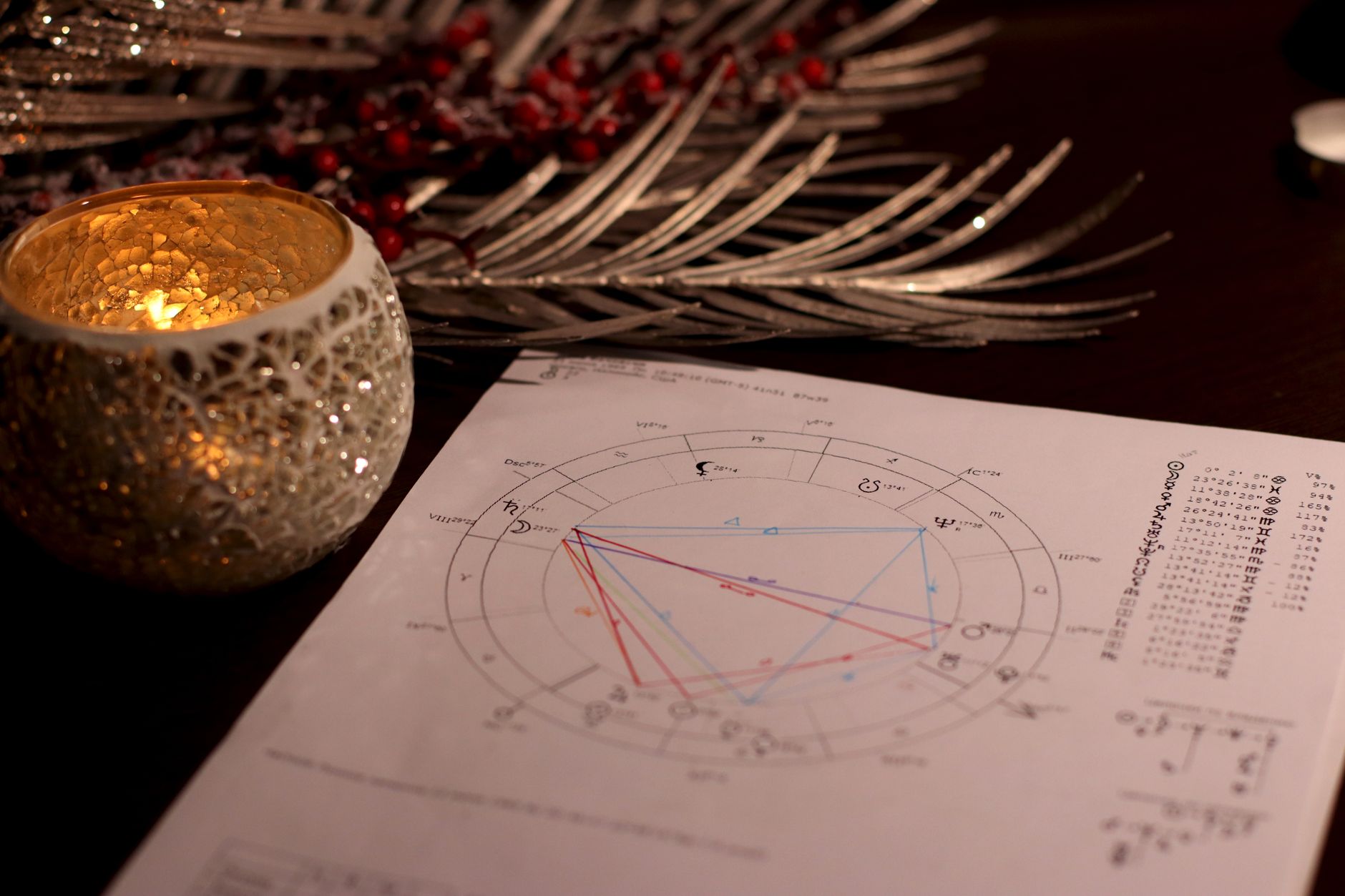
There's no placement in a birth chart labelled "empath." The word is a modern label applied to a cluster of older, specific placements: a concentration of planets in the water signs (Cancer, Scorpio, Pisces), planets in the 12th house, the Moon's condition, and hard aspects from Neptune to personal planets or the Ascendant. None of these appear on a chart as a diagnosis. They are five separate, checkable things, and a chart can have some without the others.
This guide walks through each one, with the actual degrees and orbs astrologers use to decide whether a placement counts, and a worked example showing how the pieces combine — or don't — in a single chart.
The five placements the label is built from
| Placement | What the tradition says it does |
|---|---|
| Sun, Moon, Mercury, Venus or Mars in Cancer, Scorpio or Pisces | Colours how a person processes and responds to feeling — theirs and other people's |
| Planets in the 12th house | The house traditionally read as dissolving boundaries between self and surroundings — see The 12th House |
| Moon in Cancer or Pisces, or Moon in hard aspect to Neptune | The Moon governs emotional receptivity in the tradition; its condition is weighted more heavily than any other single factor |
| Neptune conjunct, square or opposite the Sun, Moon, Mercury, Venus or Ascendant | Read as blurring the edges of identity, perception or self-interest |
| Three or more planets clustered in one water sign or house | A stellium — see What Counts as a Stellium for the actual threshold astrologers use |
A chart can satisfy one of these strongly and none of the others. A Pisces Sun with Mars in Aries and no major Neptune aspect is not read the same way as a chart with Moon opposite Neptune and three planets in the 12th house, even though both might get called "empath charts" informally.
Step 1: get the chart right before reading it
Four of the five placements above depend on house position, and house position depends on an accurate birth time — not the date, the time. The Ascendant moves roughly one degree every four minutes, which means a birth time that's off by twenty minutes can shift a planet from the 12th house into the 11th, or move the Ascendant into a different sign entirely. If the time on a birth certificate is a rounded guess, work from how to find your rising sign without a birth time before trusting any 12th house claim.
The Sun sign is stable for this purpose — it only changes roughly once every thirty days — but the Moon changes sign every two to two and a half days, so a birth near midnight close to a sign boundary needs the same care.
Step 2: count the water emphasis properly
Take the five personal planets — Sun, Moon, Mercury, Venus, Mars — because these are the ones astrologers treat as describing personality directly, as opposed to Jupiter outward. For each, note the sign.
Worked example (a hypothetical chart, built for illustration, not calculated from a real birth record):
- Sun: Pisces 14°
- Moon: Cancer 2°
- Mercury: Pisces 29°
- Venus: Aquarius 3°
- Mars: Capricorn 21°
Three of five sit in water signs — 60% of the personal planets, against a baseline expectation of 25% per planet, since each element covers three of the twelve signs (3/12 = 0.25). That's a real concentration, worth naming. But it falls short of a stellium, which by the usual threshold requires three or more planets in the same sign or house, not merely the same element. Here the three water planets split across two different signs — Pisces and Cancer — so this chart has a water emphasis but not a water stellium.
Step 3: check the 12th house separately
House position is independent of sign, and this is the step most casual readings skip. Using whole sign houses with this chart's Ascendant in Scorpio, the houses run: 1st Scorpio, 2nd Sagittarius, 3rd Capricorn, 4th Aquarius, 5th Pisces, 6th Aries, 7th Taurus, 8th Gemini, 9th Cancer, 10th Leo, 11th Virgo, 12th Libra.
Under this layout, the Sun and Mercury in Pisces land in the 5th house, not the 12th. The Moon in Cancer lands in the 9th. None of the three water planets in this example are actually in the 12th house — the 12th house here is Libra, and nothing occupies it. This is worth sitting with: a chart can be heavily weighted toward water signs and still have no 12th house activity at all, because sign and house are two different coordinate systems answering two different questions. One describes a planet's quality; the other describes where in the life it tends to operate.
Step 4: check Neptune's aspects to the chart
Neptune moves slowly — roughly fourteen years per sign — so most people born within a few years of each other share the same Neptune sign. What makes a Neptune placement personal is the aspect it forms to an individual planet or angle, not the sign itself.
In this example, Neptune sits at Capricorn 2°. The Moon sits at Cancer 2°. Cancer and Capricorn are opposite signs, and both planets hold the same degree, so this is an exact opposition at 0° orb. Astrologers generally allow wider orbs for aspects involving the Sun or Moon — commonly up to 8° — and tighter orbs for Neptune specifically, commonly 3° to 5°. An exact 0° Moon-Neptune opposition like this one would be read as significant under either convention.
This is the strongest single marker in the whole example chart — stronger, in the tradition's own terms, than the water emphasis from Step 2, because it ties the Moon (emotional receptivity) directly to Neptune (boundary dissolution) at an exact degree.
What the odds actually look like
It's possible to put a real number on how often a given water emphasis occurs, with one caveat stated up front: the five personal planets aren't statistically independent of each other. Mercury never strays more than about 28° from the Sun, and Venus never strays more than about 48°, so a Sun in Pisces makes a Mercury in Pisces, Aquarius or Aries disproportionately likely too. A clean independence calculation understates how linked a water Sun and a water Mercury really are.
With that caveat flagged, here is the naive calculation, treating each of the five personal planets as an independent 25% chance of landing in a water sign — a reasonable approximation for Mars, less so for Mercury and Venus. Using the binomial formula P(X=k) = C(5,k) × 0.25^k × 0.75^(5−k):
- Exactly 3 in water: 10 × 0.015625 × 0.5625 = 0.0879, or 8.79%
- Exactly 4 in water: 5 × 0.00390625 × 0.75 = 0.0146, or 1.46%
- All 5 in water: 0.25⁵ = 0.00098, or roughly 0.10%
Added together, "three or more of five personal planets in water" comes to roughly 10.3% under this simplified model — not rare, but not the default either. Because Mercury and Venus cluster near the Sun, a water Sun pushes the real figure higher than 10.3% in practice; stating the true figure honestly would require running the correlation through actual ephemeris data across a long date range, which is a different exercise from this one.
What doesn't count
A single water Sun sign on its own is the weakest version of this claim and the one stretched furthest online. The sign by itself says something about the Sun's placement and nothing about the Moon, the 12th house, or Neptune's aspects. Reading "Pisces Sun" as a complete marker skips every other layer this guide just walked through.
The same caution applies to Chiron, which gets cited in this context sometimes but carries far less settled interpretive weight across traditions than the Moon, the 12th house or Neptune. It's reasonable to treat it as a minor, optional check rather than a core one.
To check a real chart against this list: generate it with an accurate time and place, read off the five personal planet signs, locate the 12th house cusp and see what — if anything — sits inside it, then look specifically at the Moon's aspects to Neptune. Four separate checks, each with its own threshold, and a chart that clears none of them isn't missing anything — it's just describing a different set of tensions.
Written with AI assistance and reviewed by a person before publication. The astrology and numerology behind Amunera are computed, not generated.