
Guide · 28 September 2026 · 6 min read
Moon Sign Calculator: How It Works and the Arithmetic Behind It
Your moon sign is the zodiac sign the Moon occupied at your exact birth moment — here's the calculation the box below is running, and where it can go wrong.
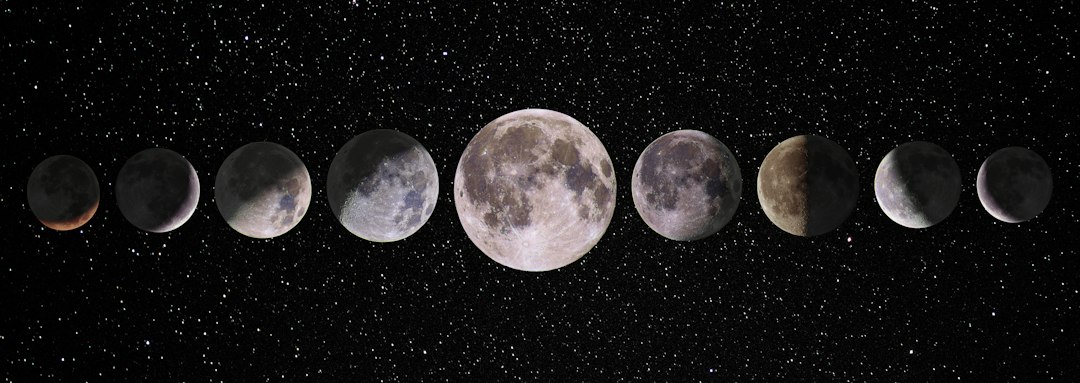
Your moon sign is whichever of the twelve 30° zodiac divisions the Moon was sitting in, along the ecliptic, at the exact moment you were born. Put your birth date, time and location into the calculator above and it does the underlying ephemeris lookup for you. What follows is what that lookup is actually doing, worked through with real numbers, and the two places people get it wrong even with a correct calculator in front of them.
What the calculator is actually computing
Every planet and the Moon has a position measured as ecliptic longitude — a single number from 0° to 360°, counted eastward from the point where the Sun crosses the celestial equator at the March equinox. Slice that circle into twelve 30° bands starting at 0° and you get the zodiac signs: 0°–30° is Aries, 30°–60° is Taurus, and so on round to Pisces at 330°–360°. A sun sign is just where the Sun's longitude falls on your birthday. A moon sign is the same idea applied to the Moon, at the same moment.
This is the tropical zodiac — the frame Western astrology uses, tied to the equinox rather than to the fixed stars. It is not the same as the sidereal zodiac used in Vedic astrology, which currently sits roughly 24° behind it because of the slow precession of the equinoxes. A calculator built for Western moon signs and one built for Vedic rashis will disagree by close to a full sign for the same birth data, and neither is wrong — they are answering different questions. If you want the full derivation of how a chart's positions are built from an ephemeris in the first place, that's covered step by step in how a natal chart is actually calculated.
The arithmetic, worked through
Suppose an ephemeris table gives the Moon's position at 00:00 UT as 24°15′ Cancer, and states that on this particular day the Moon is moving at 13.5° per day — a little above its average pace. Someone born at 18:00 UT the same day was born 18 hours later, which is 0.75 of a day.
Convert 24°15′ to decimal: 15′ is a quarter of a degree, so that's 24.25°. Cancer starts at longitude 90°, so the Moon's absolute longitude at midnight is 90° + 24.25° = 114.25°.
Movement over 0.75 of a day: 13.5° × 0.75 = 10.125°.
New longitude: 114.25° + 10.125° = 124.375°.
Leo runs from 120° to 150°, so 124.375° falls inside it: 124.375° − 120° = 4.375°, which converts back to 4°22′ Leo (0.375° × 60 = 22.5′).
So a birth at midnight has the Moon in late Cancer, and the same date eighteen hours later has it in early Leo. Nothing else about the day changed — same sun sign, same calendar date — but the moon sign flipped, because the Moon covers roughly half a degree an hour and this particular day happened to straddle a sign boundary.
Why the Moon breaks the sun-sign shortcut
The Sun takes a full year to move through the zodiac, so it stays in one sign for roughly a month and you can find your sun sign from the date alone. The Moon takes about 27.3 days to do a full circuit, so it averages 360° ÷ 27.3 ≈ 13.2° per day. Because its orbit is elliptical, that speed genuinely changes across the month:
| Point in orbit | Daily motion | Time to cross one 30° sign |
|---|---|---|
| Perigee (closest to Earth) | ~15.3°/day | ~2.0 days |
| Average | ~13.2°/day | ~2.3 days |
| Apogee (farthest from Earth) | ~11.8°/day | ~2.5 days |
At that pace, the Moon changes sign every two to two and a half days, which means roughly 40% of days have a sign boundary crossing somewhere inside them. There is no way to know your moon sign from the date alone the way you can with a sun sign — you need the time, and near a boundary you need it accurately.
Why place matters for the Moon specifically
Most planets are so far away that where you're standing on Earth makes no measurable difference to their apparent position. The Moon is the exception, because it is close — about 384,000 km on average, compared with roughly 150 million km to the Sun. Viewed from opposite sides of the Earth, the Moon shifts against the background stars by an amount called parallax, and correcting for it (moving from a geocentric position, calculated as if observed from Earth's centre, to a topocentric one, calculated for your actual location) can shift the Moon's longitude by up to roughly a degree.
A degree sounds small, but a sign boundary is a single line at a single degree. If your birth Moon falls within about a degree of 0° or 30° of a sign, the topocentric correction based on your birth location can be the difference between two different moon signs. This is one reason the location field in a moon calculator is not just there for the timezone — it genuinely changes the answer for anyone born close to a boundary, in a way it wouldn't for a sun sign or a planet further out.
The clock-time trap: timezone and daylight saving
The most common error isn't astronomical, it's administrative. Ephemeris tables are built on Universal Time (UT), and a birth certificate gives local clock time. Converting between the two means knowing the correct offset for that place on that specific date, including whether daylight saving or war-time summer time was in effect — rules that have changed repeatedly over the twentieth century and vary by country. Get the offset wrong by even an hour and, given the Moon's half-degree-an-hour pace, you can move the calculated longitude by half a degree or more, which is exactly the margin that flips a boundary case.
A calculator that only asks for a time zone name rather than deriving the historical offset for the actual birth date can quietly get this wrong for older birth dates. If your result looks off, it's worth checking what time zone rule was actually in force at your birthplace on your birth date, not just what applies there today.
If you don't know your birth time
A moon sign calculated without a time defaults to noon or midnight, which is only reliable if your birth date isn't one of the roughly two-in-five days where the Moon crosses a boundary. If you don't have an exact time, the calculator can still tell you the range of possible signs for that date and where the boundary falls, which is often enough to work with. The same missing-time problem is more severe for the rising sign, which moves through a full sign roughly every two hours rather than every two days — how to find your rising sign without a birth time covers the narrower methods available there, several of which also help narrow down an uncertain moon sign.
Moon sign next to the rest of the chart
A moon sign on its own answers one narrow question — where a fast-moving point was on one day. It's often read, within the tradition, as describing emotional temperament and instinctive reaction as distinct from the sun sign's core identity or the rising sign's outward manner, but all three come from the same underlying chart and are meant to be read together rather than separately. Sun, moon and rising sign explained walks through how the three are calculated from the same birth data and why they can point in different directions for the same person. And because the whole chart depends on getting date, time and place right in the first place, birth chart calculator: how to read the three inputs correctly is worth a look if any of your three inputs are approximate.
The Moon is also the only body Amunera reads against two entirely separate systems at once: its zodiac sign from the Western ephemeris, and the lunisolar calendar's own reckoning behind the Chinese zodiac, which tracks new moons rather than sign boundaries. They are unconnected calculations answering unconnected questions, and neither substitutes for the other.
Written with AI assistance and reviewed by a person before publication. The astrology and numerology behind Amunera are computed, not generated.