
Guide · 23 September 2026 · 6 min read
Void of Course Moon, Explained: How to Actually Work It Out
The void Moon is the gap between the Moon's last exact aspect and its move into the next sign — here's the arithmetic that finds it.
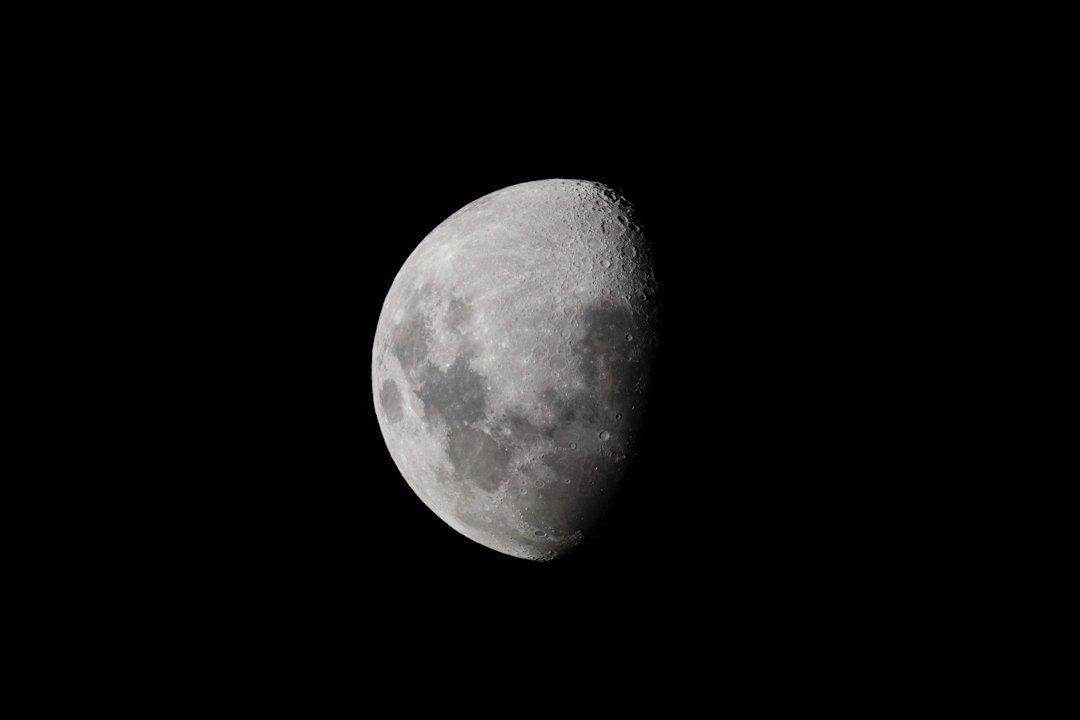
A void-of-course Moon is the stretch of time after the Moon makes its last major aspect to another planet and before it crosses into the next zodiac sign. In electional and horary astrology, that window is read as unsettled — actions started during it are traditionally said not to come to anything, because the Moon isn't finishing what it starts. The timing itself is ordinary astronomy: an exact position, a speed, and a boundary 30 degrees away. Everything else is interpretation layered on top of that.
Where the boundary actually comes from
The Moon moves through the zodiac roughly a full circle every 27.3 days, which works out to an average of about 13.2 degrees a day, or 0.55 degrees an hour. Each sign is exactly 30 degrees wide, so on average the Moon spends about 2.27 days in each one (30 ÷ 13.2 = 2.27). While it's transiting a sign, it keeps forming aspects to the other planets — conjunction (0°), sextile (60°), square (90°), trine (120°), opposition (180°) are the five the classical tradition counts. At some point in that transit, the Moon makes its last exact aspect before it reaches the sign boundary. Everything between that exact moment and the ingress into the next sign is void of course.
The part people usually get wrong is assuming the first aspect that comes to mind is the last one. It rarely is. You have to check every planet, not just the obvious one.
Working an example through
Take a Moon sitting at 24°00' Gemini, moving at the average 0.55° per hour. For the arithmetic, it helps to convert everything to a single 0–360° scale: Gemini runs from 60° to 90°, so 24° Gemini is 84° absolute.
Suppose at 3:00pm the Moon is exactly trine Mars, who sits at 24°00' Libra (204° absolute). Check: 204 − 84 = 120°, an exact trine. That looks like the last aspect of the transit — the Moon only has 6 degrees left before it reaches 90° (0° Cancer). But a trine that has already perfected at your reference time isn't the last aspect if something else perfects later, closer to the boundary. You still have to check the other six bodies.
Say Venus sits at 28°00' Aries (28° absolute). The Moon is ahead of Venus by 56° (84 − 28) and gaining, since it moves faster through the zodiac. A sextile perfects at exactly 60° of separation, which happens when the Moon reaches 88° absolute (28 + 60). From 84° to 88° is 4 degrees, and at 0.55° an hour that's 4 ÷ 0.55 = 7.27 hours, or 7 hours 16 minutes. Starting from the 3:00pm reference point, that sextile perfects at 10:16pm — nearly seven and a half hours after the Mars trine.
Now the ingress: the Moon needs to travel from 84° to 90°, a full 6 degrees, which takes 6 ÷ 0.55 = 10.9 hours, or 10 hours 55 minutes. From 3:00pm that puts the sign change at 1:55am.
So if — after checking the Sun, Mercury, Jupiter, Saturn, Uranus, Neptune and Pluto the same way — none of them perfect an aspect in the remaining arc between 88° and 90°, the sextile to Venus at 10:16pm is the true last aspect. The void period runs from 10:16pm to 1:55am: three hours and thirty-nine minutes, not the near-eleven-hour void you'd get if you'd stopped checking after the Mars trine.
This is the whole method: find the Moon's exact position and speed, find the degrees remaining to the sign boundary, calculate the exact-aspect point for every other body in that remaining arc, and take whichever one perfects latest. If nothing perfects at all before the boundary, the entire remainder of the transit is void — which does happen, though it's less common than a short gap near the end of a sign.
This is also exactly the kind of position-and-speed calculation behind how a natal chart is actually calculated, step by step — an ephemeris giving longitude and daily motion for a given moment, with everything else derived from it by arithmetic rather than guesswork.
Why some voids last minutes and others last a day and a half
The Moon's speed isn't constant. It ranges from roughly 11.8 degrees a day near apogee (furthest from Earth) to about 15.3 degrees a day near perigee (closest). That changes both the length of a sign transit and how much room there is for a void to open up:
| Moon's speed | Time to cross a 30° sign |
|---|---|
| 11.8°/day (near apogee) | 30 ÷ 11.8 ≈ 2.54 days |
| 13.2°/day (average) | 30 ÷ 13.2 ≈ 2.27 days |
| 15.3°/day (near perigee) | 30 ÷ 15.3 ≈ 1.96 days |
A void opens the moment the last exact aspect perfects, however early or late in the transit that happens to fall. If the Moon's only close aspect for that sign perfects right after it enters, and nothing else lines up for the rest of the transit, the void can run for most of two days. If the last aspect happens to perfect just before the sign boundary — as in the worked example above — the void might be a matter of minutes. There's no fixed length; it depends entirely on where the other planets happen to sit relative to the Moon's path that day, which is also why a void can't be predicted by season or sign alone. It has to be calculated fresh each time, the way exact degree placements matter elsewhere too — see critical degrees in astrology for another case where the specific degree, not just the sign, carries the weight.
The traditional exceptions
Several medieval sources on electional astrology hold that a void Moon in Cancer or Taurus doesn't carry the usual "nothing comes of it" reading, because the Moon is in its own sign in Cancer and exalted in Taurus — strong by dignity even without an applying aspect. Some later writers extend the exemption to Sagittarius and Pisces as well, on different reasoning tied to the Moon's traditional joy or its relationship to Jupiter. This isn't something an ephemeris can confirm or rule out; it's a rule of thumb from within the electional tradition, applied inconsistently between sources, and worth knowing about mainly so you recognise it as a convention rather than a separate calculation.
The timing of a void Moon is arithmetic. What it means once you have the timing is a tradition, not a measurement.
What's computable and what's a reading
The exact moment the Moon perfects its last aspect, and the exact moment it crosses into the next sign, are both fixed by the Moon's actual position and speed at that time — the same kind of figures used to work out what moon phase someone was born under, just applied to a different question. That part is verifiable against any ephemeris and will match regardless of which astrologer calculates it.
What isn't computable is the claim that a contract signed, a trip started, or a conversation had during a void period will "come to nothing." That's an interpretive layer the electional tradition places on top of the timing, built up over centuries of practice rather than derived from the mechanics of the Moon's orbit. Treat the hours as real and the meaning as a lens — useful for noticing a pattern of restlessness or delay after the fact, not for predicting which afternoon a plan will fall through.
Written with AI assistance and reviewed by a person before publication. The astrology and numerology behind Amunera are computed, not generated.